Pengikut

Khamis, 23 Ogos 2018

Rundingan Baling: Di Belakang Tabir - Bahagian xxxxv

Sambungan dari SINI...

Chin Peng: I have made it quire clear that as far as investigation is concerned this is impossible. I have no authority to accept that, unless such investigation is imposed in such a way which does not give the colour of surrender.

Marshall: What kind of investigation would you suggest?

Chin Peng:  Frankly speaking, our number is not many, our number is not very large. My suggestion to you is that out of this number, a certain number be allowed to leave this country and the others be allowed to go back freely to their homes. Government can investigate them, but they must be allowed to go back freely to their homes.

Tunku: How can we contact them? We don't know their homes.

Chin Peng: We are not going to act as we have acted in the period 1945-1948.

Marshall: The Tunku has accepted the suggestion that there will be no investigation for those who are going overseas. They can go straight to the boat.

Tunku: How many is that part - those who want to go away?

Chin Peng: This is one means by which you are asking for something from me?

Tunku:  I want to ascertain if a large number is going back, then perhaps the ones remaining need not be held for investigation,that is, if a large number is going back. If many of the leaders and a large number of followers wan to to go back to China, and those who want to remain to be citizens are few, then I won't carry on with investigation. We can work on that general line. There will be no need to carry out investigation. The only condition is that they will have to report where they are.

Chin Peng: Reporting to the Police has a touch of surrender.

Tunku: As I have said, surrender is inevitable.

Chin Peng: We can do it in this manner: allow them to come out out to rejoin society as any normal person. Then Government can send detectives to shadow them.

Tunku: Then the number of detectives will have to equal to the number of communists. Government cannot afford to do that. Will the number going to China be large?

Chin Peng: The reply to this depends on whether the  M.C.P. is recognised.

Tunku: No. In all countries, you know for yourselves, where there have struggles between communists and nationalists, they have been forced to divide up the territories. For example, Korea had to be divided, Vietnam hand to be divided. We cannot exist together either. If we accept 'no surrender' we have to divide Malay into Communist Malaya and Non-Communist Malaya. Malaya is too small. There will be constant trouble, constant warfare, if we were to divide Malaya. You know very well what I said just now - one party must give in. Unfortunately, although you do not like the word 'surrender', I have to be frank with you and say that your have got to surrender.

Marshall: Now, will you take this message back? We on our side - I am the representative of Government today, there will be elections in 1957 and I may not be the representative of the new Government, which will take its own decisions, but I will accept the decision of that Government - we ask for the welfare of the people; we genuinely do it to the best of our knowledge and ability. I appeal to you, in your activities, think of the general welfare of the  people. Personal pride should not stand in the way of the welfare of the people of a country. You who have struggled courageously if, I think, erroneously, you who have accepted deprivation and personal sacrifice, even including your lives, you should not let a matter of mild humiliation for a matter of a few months stop you from seeking the welfare of the  people. If you can see it as we see it. Once more, gentlemen, I ask - Is there a chance of our meeting on the basis of the welfare of the country?

Tunku: I think, perhaps, you won't answer the question now. I do appreciate the fact that you have come out to meet me and I feel very happy indeed. I must thank you.

Marshall: I think you can accept it both from the Tunku and myself - you have indicated certain anxiety for personal security - that the two Governments will be personally responsible to see that your return safely without molestation. The Tunku and I will be responsible. And if in future there is a chance that you can see the light, in the welfare of the people, show a change of attitude, neither the Tunku or I will consider any question of pride incoming to meet you again.

Marshall: I speak for you, Tunku?

Tunku: Yes. I want to add this: speaking n the view at the opposite end of of the poles, I did not expect very much at this talk. Nevertheless, the fact is we have an an opportunity to talk things over, to know what is in other's mind. You have time to think. Whatever may be the result, I hope you will place before everything else the peace, prosperity and happiness of the people of this country.

Tunku: I hope you are comfortable, that you had everything you wanted. Please let me know whether you want anything before I go away.

Marshall: I think they want a fan.

Chin Peng: There is nothing we want. We don't need a fan. The question is how are we going back.

Tunku: In the same way that you came. You will be escorted.

Chin Peng: That is all.


(Meeting terminated at 12.48 p.m. Source: PRO: The Baling Meeting, CO1030/31)


Menurut Harry Miller, wartawan The Straits Times yang menempah tempat di atas bukit di belakang bilik mesyuarat, beliau terdengar Chin Peng menyatakan "The amnesty means surrender. Surrender means humiliation. We will not accept surrender at anytime; we will carry on the struggle to the last man."

Bila dengar ini tu yang Tunku respons: "I will never give in, so must give in." Bila dengo ini yang membuat Chin Peng menyatakan "Chay yang hao" dalam bahasa mandarin yang bermaksud "This suits us fine" sebelum keluar dari bilik tersebut (Harry Miller, The Straits Times, The War Goes On! Amnesty to end after 'period of grace', 30 Dis 1955, hlm. 1) . Kenyataan ini tiada pula dalam transkrip.

Sebenonya, Chin Peng tidaklah mengguna bahasa gomen sepanjang mesyuarat tersebut. Tu sebab ada ketika Marshall merujuk kepada Chen Tien. Tunku mengesahkan bahawa "...Chin Peng hanya boleh bertutur bahasa Inggeris sedikit-sedikit sahaja". Itu sebabnya disediakan 2 orang penterjemah dan Chen Tien juga berperanan sebagai penterjemah (Wahba, 1994, Baling Membuka Jalan Damai, Kajang:Masa Enterprise, hlm. 186. Petikan temubual di antara Wahba dengan Tunku di No 1, Jalan Tunku, KL pada 8 Mac 1984).

Chin Peng mengaku dia mengguna dialek mandarin ketika menjawab soalan oleh Anthony Short, semasa berdialog dengan Chin Peng  di Australian National University, Canberra pada 22-23 Feb 1999 (C. C. Chin & Karl Hack, (Editors), 2004, Dialogues With Chin Peng: New Light On the Malayan Communist Party, Singapore: National University of Singapore, hlm. 174-175).     

Anthony Short: You were speaking in English?

Chin Peng: No, no, in Chinese.

Anthony Short: In Chinese, so in that case, is there a different meaning, is it a very rough translation to 'lay down arms'. Does it mean 'ceasefire' or 'to surrender weapons'? Could you recall that?

Chin Peng: To lay down arms means, if you used the present word, 'decommissioning of arms'. It could mean you hand over the arms, or it could mean we still keep the arms, just cease fire.

Anthony Short: But which was in your mind?

Chin Peng: In my mind? Our bottom line, or minimum line, if all the terms were acceptable to us, then we were ready to destroy the arms, not to hand over the arms. To destroy the arms under supervision. One, if we could get 'International Supervisory Commission', we would prefer to accept. We assumed the British would have agreed immediately. If they would have agreed, we would have agreed to set up a supervisory commission of all parties, consisting  of Malayan parties very specifically, including the oppositions, Or, if there were some Malayan prominent figures, to set up local supervisory commission, we were ready to accept that.

Berakhirlah satu perisitiwa yang begitu penting dalam sejarah negara kita tercinta ini. Ini juga buat kali terakhir Tunku bersemuka dengan Chin Peng.

Dah pastilah, Tunku selepas itu buat sidang akhbar sebelum berlepas balik ke KL sementara Chin Peng pula meninggalkan Baling untuk ke Gunung Paku. 

Untuk itu, tunggu le posting akan datang, In Syaa Allah.

Selasa, 21 Ogos 2018

Rundingan Baling: Di Belakang Tabir - Bahagian xxxxiv

Sambungan dari SINI...

Chin Peng: But if Tunku's opinion is that after he has obtained power he is afraid of subversion as has been reported int the editorial of the Straits Times of yesterday's date, I think this question is not difficult to solve.

Tunku: To me I think it is quite difficult. To me I have the clear example of Chine - because China at one time was run by forces with different ideologies - Chiang Kai Shek's Nationalist China and Mao-Tse-Tung's Communist China. What happened there we all know. The Chiang Kai Shek's Nationalist Government had to be driven out of the mainland. If I accept you on equal status I have no doubt that I and my party will similarly be driven out of Malaya before long because  our ideologies are widely different. That is plain language. Therefore you either give in to us on certain terms which we consider fair, or else this struggle will have to on, much to my regret.

Chin Peng: I have already said that we are prepared to give great concessions, but the  principle of investigation implies surrender which we cannot accept. It is humiliation to us. May I say, if you were in position, what would you do?

Tunku: Well, it all depends. If I were a communist I would probably demand the same therms that your have. But, on the other hand, I am a nationalist of the Malayan type, pure and simple. If I were a Communist and had carried on the war as you have done, I would welcome being offered Amnesty terms. On the other had, assuming that the Communist Party was in power in this country and they had been accepted by the people at large, I, as a Nationalist type, would not want war; I would give in to them. Actually the position will not arise.

Marshall: If I might paraphrase the Tunku: as a human being who seeks the welfare of the people, if the Communists were in  power he would not to shooting them, killing them, burning their houses; he  would accept the position. The Tunku is a strong nationalist and a strong democrat and he says that if the Communists were in power as the Government with bullets, with knives and with fire, because he considers the welfare of the people. He would loyally accept he Government.

He appeals to you now as a nationalist to be loyal to the Government oi accept the decision of the people, for thee welfare of the people.

I would like to add my voice to his as a human being. There are 7,000,000 people in Malaya and Singapore. There are about 3,000 communists. The welfare of the 7,000,000 must come first. Now that we have elected Governments and we are on the verge of independence, it cannot be said that your struggle is for independence. I appeal to you to think of the welfare of the people as a whole, even it it means a certain humiliation of the 3,000: if you you seek the welfare of the people, you should not put your pride before their welfare. Could you look at the question from the point of view of what is good for Malaya? Certainly, it is not the hostilities of today. Today, I am not talking about the past, it is doing harm to the people of Malaya. Why not accept the position, even it it means slight humiliation. You have accepted sacrifices in the past, so accept the sacrifice of humiliation and serve the people by coming out and put an end to these hostilities.

Tunku: I want to give an example. It happened in my Organisation. I was int he U.M.N.O. when Dato Onn was the leader, but Dato Onn did not agree with me  in all matters. Nevertheless, I remained within the U.M.N. O. without quarreling. Eventually it proved I was right and he was wrong and therefore he went out and I came in. It happened again within the Alliance itself. M.C.A. Selangor wanted to join U.M.N.O. Sir Cheng Lock Tan did not want to join U.M.N.O. but wanted to join I.M.P., but when he found that the majority of the people wanted to join U.M.N.O. he gave in. It is a principle that works well for an Organisation of that size. I think it can work very well with the Government too. But our two ideologies cannot work side by side. Either you give in or we give in. If you will not, the struggle must go on.

Chin Peng: May I ask one question? May I know the true reason why the Tunku wants us to surrender? Is it because of our threat to this leadership or may there be other reasons?

Tunku: No. Not because of any threat of my leadership at all, because I do not think it can be threatened at this moment. It is because I want peace. There can never be peace while these two ideologies conflict very strongly one with another. I want peace; that is why I ask you for the sake of the masses of the people of Malaya, the 7,000,000 - as was said just now - to accept our ideology. You are only a few thousands - I mean your many less than us. So for the sake  of peace, I think those fewer people should give in to to us. Later these fewer people may grow stronger and if they are stronger we will give in to them.

Marshall: Is there a chance of you reconsidering this?

Cukup le buat hari ini. Bersambung, in syaa Allah.

SELAMAT AIDIL ADHA. MAAF ZAHIR & BATIN 
   

Isnin, 20 Ogos 2018

Rundingan Baling: Di Belakang Tabir - Bahagian xxxxiii

Bersambung dari SINI...

Marshall: Can I ask: Whether pending the return of the Tunku, and recognising the serious set-backs to the economic life of the country which are brought about by your activities, you would refrain from activities which endanger life and property of the citizens of the country?

Chin Peng: Long ago we announced that we advocated a general cease fire. As I have said just now, even from today until the day when the Tunku returns from London, we can arrange for a general cease fire.

Tunku: The point is that we have done that before. We are the only party which respected it; your party carried on as if there was not general cease fire declaration at all.  

Chin Peng: The point is that Government's declaration did not declare that there would be a stop to offensive activities by Government forces - they attack us all along.

Tunku: That is not quite true. I most cases, although the cease fire was given, the Government troops were also ordered not to shoot at sight but to challenge first, and this they did. If the Amnesty terms are not unacceptable to you, then do you agree that they must be withdrawn?

Chin Peng: It it comes to that we cannot help it.

Tunku: I will have to announce tomorrow that  the Amnesty terms will have to be withdrawn.

Chin Peng: There is no question of that.

Marshall: Are you in a position to speak for the Communists in Singapore?

Chin Peng: Yes. But I cannot control those who have been sent there by the Special Branch of the Police.

Marshall: Are you suggesting that the Government sent Special Branch people to infiltrate into the Communist party?

Chin Peng: There is nothing curious about that. They have, but I cannot tell you the number.

Marshall: What one earth for?

Chin Peng: There are those who call themselves Communists, but in fact, they were sent there by the Government. They are, in reality, the detectives of the Government. How can I control these people?

Marshall: You said you control the activities of the Communist in Singapore?

Chin Peng: Yes, that is right. I wish to clarify one point. In Singapore we discovered a lot of such cases, not a few but quite a number. I do not say a lot, but not little. The Special Branch of Singapore have infiltrated into our Communist party by sending people to join our Communist party. Such people will not listen to us, but they make use of our name to do what they like. That is exactly what happened in the Hock Lee Bus Company strike.

Marshall: You mean to say that whenever activities of a character which are unpopular to the public are committed by the Communist party, you disown them by saying that the Communist spies have committed them?

Chin Peng: If we are responsible for any such activities, we say so. If we make a mistake, we accept it. Once we announced publicly that we accepted our mistakes in collecting identity cards and destroying them. But the strike at Hock Lee Co. is not one we would like to do. I want to reiterate once again. Under such circumstances we have no wish to create chaos. Of course we would lead the labourers in strikes and in their struggle, but we do not wish to have such unfortunate incidents. In that strike - although I have not received detailed information but I have reports- there are people who willfully incited the labourers to do the things they have done. They openly said that they wanted to carry on their struggle until independence has been achieved. Such a slogan cannot be that of the Malayan Communist Party. We members of the M.C.P. will never utter such slogans.

As regards the question of the terms of the Amnesty, I wish to say a few words. The primary question is investigation. Such an investigation, no matter how it is explained, implies that we come out to surrender. It is impossible to want us to come out and surrender. If you demand our surrender we would prefer to fight to the last man. I am not telling a lie, I am telling the truth. If the question of the principle on investigation can altered, we would give even greater concessions.

Marshall: Do I understand that even if the Federation has control of internal security and local armed forces and achieves independence, you will not consider coming out if the Government insists on investigations before release?

Chin Peng: As regards investigation, supposing we return to you respective homes and then the Government starts to investigate us, then it is a different matter. But if we were to enclosed in one place and investigations are to be carried out, that amounts to surrender.

Tunku: I want to make it quite clear to you. As I said yesterday, our ideologies are completely at variance. As I said, in one case you will go to extremes in order to enforce chaos even to the extent of taking up arms. Again, your organisation is a very powerful one. It has got support form within and aid from without. In fact, we would be  powerless to control your movement, if you were to come out of the jungle and put yourselves on the same level and the same status as we are. Therefore if you do not come out to surrender, we would rather not accept you in our society. If you want to have peace in this country, one side must give in  - either we give in you, or you give into us us. The two ideologies, yours and ours, can never work side by side. That is my frank opinion. 

Cukup le setakat ini saje dulu. Dah 3 hari berturut-turut menaip transkrip ini. Tapi tak apa...demi cinta terhadap negara Malaysia.

Bersambung, In Syaa Allah.

Ahad, 19 Ogos 2018

Rundingan Baling: Di Belakang Tabir - Bahagian xxxxii

Bersambung dari SINI...

Marshall: And Singapore National Forces and Federation and Singapore Navy - that sort of thing?

Tunku: You mean that if Singapore doesn't get control of internal security and the Federation does...

Marshall: Don't assume that, Tungku. Forgive me, Tungku, my Government will not remain in power if we don't get control of internal security.

Tunku: I have got make my point because I am going to London before you.

Assuming the Federation gets control of internal security and national defence and Singapore doesn't, would you give up the struggle, or would you want both territories to get it before you give up?

Marshall: May I put it this way. The Tungku is coming back in February, and he expects to have complete  control of internal security by February. I will be going in April and will expect to be back in early May, and ewe expect then to have control of internal security. So the question is, if the Federation gets it in February, will you come out in February without waiting for Singapore, because we going to be three months later?

Tunku: The fighting is in the Federation.

Marshall: Forgive me for interrupting but I want this to be clear - I will say it again.

The Tungku is going to London the day after tomorrow and he will be coming back February 12th or 15th, and he will have then an agreement that he will have control of the internal security and national defence. He stands or falls by that. I am going in April. I will come back by mid-May, and if I do not have control of internal security and national defence I am going out - the Government is going out. So the question is, you see, there will be three months' difference between February and May - if in February the Federation has got control of internal security and national defence will you come out without waiting for Singapore?

Chin Peng: If Tunku obtained control in matters concerning internal security in February - and national defence - then we will stop our hostilities at once and we will not wait for the result of Mr. Marshall's mission.

Or armed forces are called "National Liberation Army". When we have attained our object, in other words, when this country is already liberated, then there is no point continuing the existence of this army.

Marshall: I agree.

Chin Peng: But by that time will we still be subject to investigations?

Tunku:  That another point. Would you ask for any terms before you throw down your arms?

Chin Peng: This question is very simple. The answer is very simple. If the M.C.P. is recognised, if members of the M.C.P. are not subject to detention and investigation, they can throw down their arms at once. The question of weapons can be solved easily. (Interpreter: I don't know what they actually mean by that).  

The downing of arms does not mean that the arms will be handed in (repeats) is not equivalent to the handing over  of arms to Government. 

May I repeat: the downing of weapons is not equivalent to the handing over of weapons to Government.

Tunku: They want to keep their arms?

Chin Peng: If only the M.C.P. is recognised; if only we are  not subject to restriction of our liberty, it is possible for us to surrender our weapons,

Marshall:  Now?

Chin Peng: After Tunku's return form London when he has attained his aims.

I maintain that what I have said just now is quite correct. Because the conditions laid down in the proclamation - in the Amnesty declaration - is that the downing of arms is not surrender of arms.

Tunku:  I don't quite follow his for the moment. It would convey to me the meaning that because in the amnesty terms there is a mention of the laying down of arms - it means that when they surrender they would still be allowed to keep their arms,

Chin Peng:  That is how we interpret t it.

Tunku:  Oh, no, it is not. The conditions are obvious. If, after you surrender, pi were jot happy with certain things it would mean that you could again take up arms if you do not surrender your weapons.

Chin Peng:  That being so, then we have misinterpreted the terms.

Marshall:  At first I understood them  to say that as soon as the Federation gets control on internal security and local armed forces, they will come out. Mr. Chen Tien, I will read out this note to you and then I will hand it to you: "As soon as the Federation obtains control of internal security and local armed forces we will end hostilities, lay down our arms and disband our forces." Would you initial that because I wan to issue it to the Press.

(Paper passed to Communist side. Catatan Marshall dalam dakwat hijau: "That as soon as the elected Government of the Federation obtains complete control of internal security and local armed forces, we will end hostilities, lay down our arms and disband our army") 

Chin Peng:  The question is: If we disband our army, are we also subjected to investigation?

Tunku:  That I sill have to decade later; I won't say it now. I am only talking now on our Amnesty offer. I will have to get a further mandate form the Alliance National Council and the U.M.N.O. General Assembly.

Marshall: Do they accept that?

Chin Peng: I will accept that with an amendment.

Marshall: Perhaps Mr. Chen Tien would like to put the amendment on the paper.

Chin Peng:  I will accept it with an amendment: "that is not equal to the fact that we accept the terms of the Amnesty."

Tunku:  Quite right: I understand. You mean provided it does not mean surrendering under the terms of the Present Amnesty? The present Amnesty terms are only going to be on offer for about another month form today. If there is to a further Amnesty, it may be different. The present Amnesty cannot go on for ever. It has got to end at some time. 

Sumber: Dr. Nik Anuar, op. cit., hlm. 67

Marshall:  The note with amendments now reads: "That as soon as the elected Government of the Federation obtains complete control of internal security and local armed forces, we will end hostilities, lay down our arms and disband our army. It does  not amount to accepting the present Amnesty terms." (Pindaan oleh Chen Tien). Are we to understand that you are not prepared now to consider the question of the present Amnesty terms or any extension of them or any amelioration of them?

Chin Peng: No.

Cukup le untuk hari ini. Bersambung, in syaa Allah.

Sabtu, 18 Ogos 2018

Rundingan Baling: Di Belakang Tabir - Bahagian xxxxi

Bersambung dari SINI...

29 Dis 1955...

Jam 0700...Seorang Pegawai Turus Tentera Darat bertolak dari Baling ke Kulim dengan kereta. Dia membawa salinan transkrip mesyuarat hari pertama untuk diserahkan kepada Tunku, Marshall dan Cheng Lock Tan. Selepas itu dia meneruskan perjalanan ke RAF Base Butterworth dimana sebuah pesawat sedang menunggu untuk menerbangkan transkrip kepada MacGillivray, Jen Bourne dan Principal Staff Officer di KL. Selepas itu, pesawat berlepas ke Singapura untuk menyerahkan transkrip kepada Gobenor Singapura, Black.

Jam 0830...Rombongan Tunku berlepas dari Rumah Rehat, Kulim ke Baling dengan diiringi oleh pasukan 15/19 Hussars.

Jam 0945...Chin Peng memohon kepada John Davis mengatur pergerakan Lee Chin Hee dan Tan Kwee Cheng untuk kembali ke Klian Intan untuk menyertai semula pengiring-pengiring Chin Peng di kaki Gunung Paku. Permohonan ini diluluskan dan kedua-dua mereka dihantar balik ke Gunung Paku dengan diiringi oleh PPH.

Jam 1018...Rombongan Tunku tiba di Baling.

Jam 1050...Sesi keempat bermula. Tetapi sebelum itu, Tunku mengadakan sesi photography untuk para wartawan. OK le. Kali ini saya salin semula transkrip perbincangan tapi dalam bahasa gomen (Nik Anuar, op. cit,, hlm. 84-96).

Tunku: Shall we begin? Yesterday, the discussion revolved around three points. First, recognition of the Communist Party. We have told you in no uncertain terms that we would not agree to recognition of the Communist Party. Next is detention. On this point you said you would not want ti be detained or investigated. But I think I have explained to you (although I do not know whether you understood it or not), that the period of detention would be only for as long as is necessary to hold the  investigation, no longer that that. I think I have explained to you the difference between the detention which understand and the detention which we proposed in the of surrendered Communists. Correctly speaking, it is not detention at all; we intend to hold you for investigation. You, I understand, do not agree with that. You propose that as soon as agreement is reached whereby there shall be peace. you should then be allowed to come out and go wherever would like, freely. To that, we cannot agree for the reasons which I explained yesterday.

Then again, you suggested that there should be no investigation held to ascertain whether you are loyal or not. We feel that investigation or an inquiry, if you like the term better that "investigation" must be held. Investigation does rather suggest investigation into all your past acts. What we aim to do exactly is to ascertain whether you wan to be loyal citizens of the country or not. For that reason I would rather call it an "inquiry".

Then there was the third point, which was suggested by you and amplified by the Chief Minister, Singapore. For those of you who wish to go to China, or for that matter to any other country, we should be pleased to help you to go. For these people I don't think an an investigation would be necessary at all. All we need to know from them is where they want to go. Then arrangements will be made for their passage and  pocket money will be given to them - enough to see that they are well looked after in that country.

I reiterate again that only those persons who want to stay in Malay and make their homes in this country will be investigated. 

We have only two hours this morning because I have got to go back and pack my things to go to England, so I hope we can come to some agreement on these points, and I think it would be better to come straight to the point without beating about the bush.

I appreciate that you have got to obtain the best possible terms before you can agree to surrender, and I understand that attitude. So I would like to hear what you to say.

Chin Peng: If the conditions as lain down cannot be changed, then I am not empowered to accept therm.

Tunku: How can they be? As I say, they cannot be so changed that we give up investigation - that would be absolutely wrong. 

Chin Peng: There is no need for me to repeat what I said just now. What I have said just now is very, very clear.

Marshall: I think we have cleared one point - that those who are free can take part in political activities. But we must have investigation and perhaps they would like to discuss the question of duration of this investigation, accepting the principle that is something which the people will required, then I thing this line of though might be fruitfully discussed.

Chin Peng: This is a question of principle. I am not empowered to discuss this principle. My answer in this matter  is very plain.

Since we have only a short time available, I wish to say a few words. The present Government, although it is a popularly elected Government still is not an independent Government. 

Marshall: Tell him wee recognise that fully.

Chin Peng: Under such circumstances, therefore, when we bring out our suggestions we have got to have regards to this situation. If these popularly elected  Governments of the /Federation and Singapore have self-determination in matters concerning internal security and national defence, then all problems could be solved easily. As soon as these two Governments have self-determination in internal security and national defence matters, then we can stop the  war immediately.

Tunku: Is that a promise? When I come back from England that is the thing I am bringing back with me.

Chin Peng: That being the case, we can straightaway stop our hostilities and also disband our armed units.

Marshall: You say that as soon as the two Governments have control of internal security and national defence you will end hostilities and lay down your arms and disband your armed forces. Mr. Chan Tien, is this right please?

Tunku: There is one word "self-determination". 

Chen Tien: Not self-determination  - full power to control internal security.

Tunku: One of the purposes for which I am going to England is to get control of internal security. When I do get that, are saying that your prepared to accept our terms and lay down your arms, if the terms come from me?

Marshall: What do you mean by "national defence"? Do you mean control over all internal forces?

Chen Tien: National defence includes control over all armed forces within the country.

Marshall:  You say "national defence" means control over the armies within the country?

Chen Tien: At least local forces.

Marshall: Local forces? Fair enough. Would you in those circumstances accept these terms?

Chen Tien: To give an example - control over the Malay Regiment, the Federation Regiment. 

Letih juga menaip transkrip ini. Maklum saje la...saya merangkak mencari abjad 'typewriter' ini. Bersambung, In Syaa Allah.

Isnin, 13 Ogos 2018

Rundingan Baling: Di Belakang Tabir - Bahagian xxxx

Bersambung dari SINI...

Jam 1530 mesyuarat di rehat sebentar untuk pertukaran juruterengkas (stenographers) untuk sesi kedua. Yeo dan Ratnam diganti oleh Wong Loong Seang dan Prakabharam. Yeo dan Ratnam nak sediakan transkrip. Sementara itu, Tunku dan delegasi dihidang dengan kopi tapi delegasi komunis meminta jus oren dan soda.

Tidak lama kemudian, jam 1540 bermula sesi kedua dan berakhir pada jam 1745 (The Straits Times pula melaporkan jam 1715 delegasi komunis berjalan ke bilik mereka (The Straits Times, Across seven years (and a fence) two brothers meet again, 29 Dis 1955, hlm. 2). Delegasi Tunku beredar ke rumah tuan DO untuk minum teh. Depa jalan kaki saje. Chin Peng pula berjalan ke bilik penginapannya yang jaraknya must be the shortest par 3...dekat bebeno.

Semasa rehat, staf gomen pula sibuk membuat draf kenyataan rasmi yang akan dikeluarkan nanti.

Pada lebih kurang jam 1715, Rashid keluar dari bilik melalui pintu belakang apabila terdengar orang memanggilnya. Apabila dia memandang ke arah bukit, dia ternampak dua orang. Mereka ialah Shahrudin Maidin, adiknya (lain ibu) dan seorang wartawan. Bila terpandang sahaja Rashid, Shahrudin memberitahu kepada wartawan "Yes, that's him." Shahrudin adalah seorang Inspektor Home Guard. Bila terbaca laporan akhbar yang abangnya berada di Baling, Shahrudin pun bertolak dari kampungnya, Kpg. Gunung Mesah, Gopeng, Perak. Dia orang negeri saya yop! Menurut Shahrudin, kali terakhir dia bertemu dengan abangnya semasa melawatnya di Kem Tahanan Tanjung Beruas, Melaka pada  1948. Keluarga Rashid putus hubungan apabila Rashid berjaya meloloskan diri pada 1951 dan dia dianggap telah mati. Dalam memoirnya, Rashid mencatatkan Yusof Maidin (Rashid Maidin, cit. op., hlm. 75). Datuk Mohamed Yusof Maidin merupakan seorang Adun Negeri Perak selama 3 penggal bermula pada 1974.

Tapi mereka hanya mampu berpandangan saje beberapa minit sebelum Rashid masuk semula ke dalam bilik. Delegasi komunis dilarang sama-sekali berkomunikasi dengan sesiapa pun di luar pagar perimeter sekolah. Sama juga Shahrudin dilarang bercakap dengan abangnya. (Dalam bukunya, Rashid Maidin, op. cit., hlm. 75, mencatat bila namanya dipanggil semasa delegasi Chin Peng berada dalam bilik penginapan setiba dari Klian Intan, dia dengar namanya dipanggil. Saya lebih condong kepada laporan akhbar kerana kemungkinan besar Rashid tak begitu ingat. Almaklum saje le...buku dia diterbitkan pada 2005.) Pokoknya, kedua adik-beradik ni dapatlah juga melepaskan rindu walaupun hanya sekadar pandang dari jauh saje.

Jam 1830...Para delegasi mengambil tempat masing-masing.

Jam 1840...Sesi ketiga. Pada lebih kurang jam 1900, Chin Peng menyuarakan kewujudan perakam suara yang tergantung pada siling. Dia mengesyaki ada seseorang yang mengawasi persidangan dan nak memeriksa bilik bersebelahan. Tunku menjelaskan bilik bersebelahan menempatkan perkakasi sistem perakam dan mempersilakan mereka memeriksanya. Mereka pun pergi le memeriksa sekeliling bilik rundingan dan juga bilik bersebelahan. Selepas berpuas hati, mereka masuk semula ke bilik rundingan.
Sesi ketiga : Jam 1840-2005 

Jam 2005...Mesyuarat ditunda pada keesokan hari, 29 Dis, jam 1030. Sebelum bersurai, Tunku memaklumkan Chin Peng bahawa mesyuarat keesokan hari mesti berakhir pada tengah hari kerana beliau ada temujanji yang beliau perlu hadir.

Delegasi Chin Peng pula berjalan ke bilik kediaman dengan diiringi oleh John Davis dalam keadaan "...almost in despair." Apakah agaknya perasaan delegasi komunis? Menurut seorang yang turut hadir, "Chin Peng has been very reserved since the end of the talks today. He has shut all the windows of his house. They were talking inside." (Harry Miller, The Straits Times, Chin Peng gets his answer, 29 Dis 1955, hlm. 1).

Chin Peng "...a thoroughly dejected man"

Mengapa dia begitu kecewa? Tuntutan paling utama mereka ialah pengiktirafan PKM sebagai sebuah parti. Dalam kenyataan rasmi yang dikeluarkan pada jam 2255, secara rasminya gomen  menegaskan tidak sama sekali; "The reply was unequivocally 'Yes.'" yang PKM TIDAK SAMA SEKALI DIIKTIRAF. Noktah.
Ketegasan Tunku menolak tuntutan ini dikagumi oleh Datuk Gurdial Singh (kiri. Sumber: TMK) yang ketika itu bertugas di luar bilik rundingan. Menurutnya, "Walaupun suasana tegang apabila Rasyid Maidin menumbuk meja, Tunku masih senyum dan tetap dengan pendirian tidak mengiktiraf PKM." (Azman Md Noor, Utusan Online, Ketegasan Tunku tolak PKM dikagumi, 31 Dis 2012).
Ini bererti, Tunku, Marshall dan Cheng Lock Tan sebulat suara menentang PKM. Jadi, macam mana Chin Peng nak kata semua rakyat Malaya menyokong mereka? Cheng Lock Tan yang mewakili MCA menyatakan:

"As the M.C.P. consists mostly of Chinese, it is the Chinese community who have suffered most in the last eight years  of the Emergency and therefore as Chinese we particularly wish that there will be peace and an end to this war. We hope at this meeting to put forward propositions which will end the Emergency. There is no hope of the M.C.P. winning. Why waste money unnecessarily on the Emergency, there us no point in that. The vast majority of the people of this country are not in favour of the communists because they are not working for a prosperous Malaya and communism sets class against class and causes disorder. Malay and communism sets class against class and causes disorder. Th e other reason is that communism is distasteful because it causes violence. What we want in this country is peaceful cooperation and co-existence for us all and this can be obtained if you will come out of the jungle and become peaceful citizens and be loyal to this country. We want this Emergency to end so that there will be peace in Malaya. Communism is like a disease sucking out the blood of Malaya and will cause the ruin on the country." (Nik Anuar, op. cit., hlm. 57).

Para steno pula berpeluh le menyediakan transkrip perbincangan hari itu.

Sebelum rombongan Tunku berlepas ke Kulim dengan diiringi oleh pasukan 15/19 Hussars, Tunku menghubungi MacGillivray di King's House melalui hot line untuk melaporkan mesyuarat tersebut.

Kali ini saya tak nak kepilkan transkrip seperti sebelum ini. Sesiapa yang nak membaca transkrip dalam BM boleh membacanya dalam buku berikut:

Wahba (Wan Hamzah Awang), (1994), Kajang: Masa Enterprise. Tajuk asal ialah Detik Sejarah Runding Baling, (1985), Kuala Lumpur: Utusan Publications & Distributors Sdn. Bhd. 

Cukuplah buat hari ini. Bersambung...In Syaa Allah.

Selasa, 7 Ogos 2018

Rundingan Baling: Di Belakang Tabir - Bahagian xxxix

Bersambung dari SINI...

Semua dah ambil tempat masing-masing. Seperti biasa la...bukan terus nak bincang objektif mesyuarat tersebut. Tunku memulakan dialog (ANM [Alor Setar], Pan Lay Nee, Lee An Ngah & Gee Bee Sim, Rundingan Baling, UUM, tanpa tarikh):

Tunku: Awak semua sudah makan?
Chin Peng: Ya. Sudah.
Chen Tien: Sudah.
Tunku: Adakah awak berasa letih?
Chin Peng: Tidak.
Chen Tien: Tidak.
Rashid Maidin: Tidak.
Tunku: Awak ada rokok?
Chin Peng: Ya (sambil menunjukkan sebungkus kotak rokok cap Players).
Marshall: Awak hisap paip? (kepada Rashid).
Rashid Maidin: Ya.
Marshall: Tembakau cap apa?
Rashid: (mengangkat sebuah tin)...Old English.

Dengan ini, bermulalah mesyuarat...Sesi Pertama...

T    = Tunku Abdul Rahman.
C    = Chin Peng.
M   = David Marshall.
D   = Cheng Lock Tan.
CT = Chen Tien.


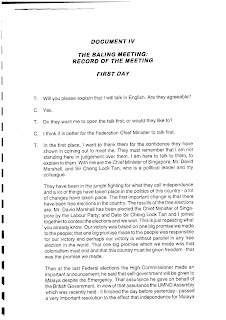
Transkrip Sesi Pertama jam 1430-1530. Sumber: Prof Madya Dr. Nik Anuar Nik Mahmud, hlm. 50-55.

Cukup le buah hari ini. Bersambung, In syaa Allah.